



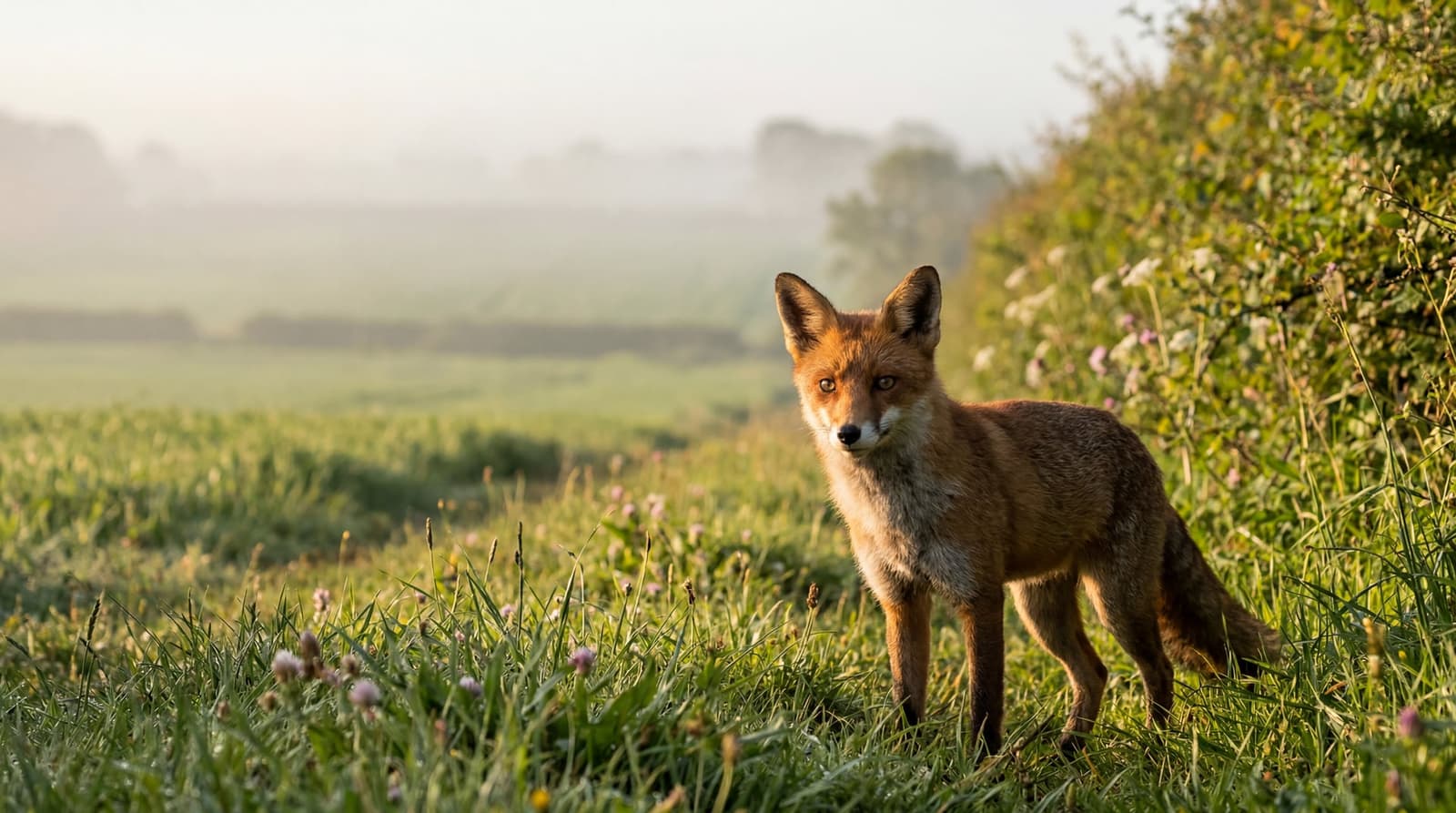


Somerset's fox count just doubled in 10 days. That's a problem.
A county citizen science project logged more red foxes in a week and a half than official records typically capture in two years, exposing a structural blind spot in how Britain monitors its most familiar wildlife.

Volunteers in Somerset recorded 44 red foxes in 10 days this summer, roughly double the annual average logged across the entire previous decade. The figure, released by Somerset Wildlife Trust at the close of its fourth annual Big Count, is being framed by organisers less as a triumph than as a warning: one of Britain's most recognisable mammals has been quietly slipping out of the country's biodiversity records for years.
The Big Count 2025 ran from 16 to 25 June and asked residents to photograph and upload sightings through the free iNaturalist app. Participants generated more than 630 new species records and identified close to 100 species, according to Somerset Wildlife Trust. The four-year running total now sits above 3,000 records. The event was funded by the National Lottery Heritage Fund and will return for a fifth year in 2026.
The headline number is the fox. Somerset's State of Nature Report 2023 found that an average of just 22 red foxes were recorded across the county each year between 2010 and 2019. The 2025 Big Count surpassed that figure twice over in less than a fortnight.
A data gap hiding in plain sight
For 2025, organisers added red foxes, rabbits, and hares to the species list for the first time. The reason, said Somerset Environmental Records Centre (SERC) Manager Ellen Phillpot, was a glaring absence in the data.
Work on our Somerset State of Nature report identified a lack of records for common terrestrial mammals; due to this we have added the red fox, rabbits and hares to this year's count. Records collected here will help in identifying population sizes and help direct our conservation and survey efforts.
Ellen Phillpot, Manager, Somerset Environmental Records Centre
SERC, the principal biological reference centre for the county, holds more than 3 million species records. The vast majority concern rare or legally protected species, the kinds that trigger statutory survey work and planning conditions. Animals widely assumed to be everywhere, foxes, rabbits, hedgehogs, hares, generate comparatively little structured data because no one is paid to count them.
That is the paradox the Big Count is built to expose. A county-scale dataset of 22 fox sightings per year over a decade is not a measurement of fox abundance. It is a measurement of how rarely anyone writes a fox down.
Ellen Phillpot, Manager, SERC
Why the fox matters
Nationally, the picture is more troubling than the fox's cultural ubiquity suggests. The British Trust for Ornithology's Breeding Bird Survey, which also tracks mammals encountered by surveyors, found UK fox abundance fell by approximately 46% between 1995 and 2021, a figure cited by The Fox Project and widely referenced in conservation literature. DEFRA's last broad population estimate, from 2013, put the UK fox population at around 430,000. There has been no comparable government estimate since.
The People's Trust for Endangered Species' Living With Mammals survey has separately reported a continuing decline in rabbit sightings into 2025, while still placing foxes among the top five most frequently seen UK garden mammals. The two findings sit together uneasily: a species can be both commonly seen and in steep decline, particularly when the baseline was never properly measured.
Nida Al-Fulaij, chief executive of the People's Trust for Endangered Species, told the National Biodiversity Network the public's contribution is now central to filling that gap. "The important data collected, with the help of the public, are vital to our work," she said. "This information on the distribution, abundance and conservation status of many much-loved wildlife species really helps PTES support direct conservation efforts."
From smartphones to statutory planning
The Big Count's records flow through iNaturalist, whose research-grade observations are shared with the Global Biodiversity Information Facility and, in the UK, with the National Biodiversity Network. UK users are the fourth-largest national contributor to iNaturalist's global growth, according to the NBN's 2025 review.
That pipeline matters because county-level biodiversity data now has statutory weight. Somerset Council's February 2024 biodiversity net gain guidance drew directly on the Somerset State of Nature Report, the same document whose data gap the Big Count is now trying to close. Developers, planners, and ecologists assessing local impact rely on the records SERC holds. Thin data on common species means thin protections for them.
Becky Fisher, head of engagement at Somerset Wildlife Trust, framed the appeal in simpler terms. "Citizen science is such a quick and easy way of helping wildlife at home, or from anywhere across the county," she said in the trust's post-event statement.
What the doubling actually means
The instinct is to read 44 foxes in 10 days as evidence the fox is doing fine in Somerset. Ecologists caution against that reading. The Big Count's design, a fixed 10-day window, a defined species list, a smartphone-based platform with photo verification, is intended to produce comparable year-on-year data, not a population estimate. What it reveals is observer effort. The previous decade's average of 22 foxes per year was almost certainly never a real count of Somerset's foxes. It was a count of how many foxes professional and amateur recorders happened to log while looking for something else.
The implication cuts both ways. If chronic underreporting has masked the true scale of fox presence in Somerset, it has equally masked the true scale of any decline. The BTO's 46% national drop is invisible in a county dataset that recorded an average of 22 animals a year.
Somerset's 2023 State of Nature report identified foxes and dormice among the mammal species in decline locally, alongside well-documented losses in insect and butterfly populations. The Big Count will not, on its own, reverse those trends. What it can do, organisers argue, is build the kind of repeatable, granular record that lets conservationists and planners see a decline coming before the species in question is rare enough to attract statutory attention.
That is the awkward truth the fox numbers point to. Britain's monitoring system is good at counting what is already endangered. It has been considerably worse at noticing what is on the way there.
Related stories
Northern Ireland's rarest rainforest gets a 100-year reboot in Tyrone
Ulster Wildlife has planted nearly 30,000 native trees at Lenamore Wood, the first Northern Irish site in Aviva's £38.9m Celtic Rainforest programme. The genetic detail matters more than the photo op.
Four Jersey beaches flunk bacteria tests as island bakes in record May heat
Officials blame rainfall runoff for 'poor' water quality at Plemont, Grouville, Havre des Pas and Victoria Pool, even as Jersey breaks its all-time May temperature record.
SpaceX's Starship V3 ends in planned Indian Ocean fireball, two days after $80B IPO filing
Flight 12 broke a seven-month launch drought and delivered most of its test goals. The timing, just 48 hours after SpaceX's S-1 hit the SEC, gave the spectacle a second audience: Wall Street.
UK's River Wye gets a rights charter. Will polluters notice?
Herefordshire and Powys councils have adopted the first source-to-sea rights charter for a UK river. Campaigners and lawyers are already asking what it actually changes.
Keep Reading
Assyrian Christian Among 85,000 Prisoners Released in Iran Amid Coronavirus Pandemic

The race to shrink the astronaut gym before Mars
Rare four-chick osprey brood hatches in Dorset as southern England recolonisation accelerates

Six eggs used to cost £1. Here's why they're now £2.

In Cambridge, a paycheck no longer keeps workers out of the food bank