





In Cambridge, a paycheck no longer keeps workers out of the food bank
The UK's most unequal city is now feeding employed residents through subsidised food clubs, raising questions about whether wages or housing will ever catch up.

Cambridge City Foodbank says a growing share of the people walking into its eight Welcome Centres and six subsidised food clubs are not unemployed. They have jobs. They simply can't afford to eat after paying the rent.
The charity, an independent member of the Trussell network, told the BBC that Cambridge's cost of living has outstripped local wages to the point where workers in the city now need subsidised groceries to get through the week. The foodbank distributed 17,665 three-day emergency food parcels in 2024, an 11% rise on the year before, and is on track to deliver more than 250,000 meals in 2026, according to its chief executive Steve Clay, writing in CambsNews.
The numbers sit awkwardly against the city's global reputation. Cambridge anchors the so-called Silicon Fen tech cluster, hosts one of the world's wealthiest universities and posts some of the highest average weekly earnings in the UK. It is also, by the Centre for Cities' measure, the most unequal city in the country.
A working person's crisis
The structural picture is stark. Average private rents in Cambridge reached £1,800 a month in April 2026, against a UK average of £1,381 and an East of England average of £1,278, according to the ONS Price Index of Private Rents. The average house price hit £472,000 in March 2026, with first-time buyers paying £394,000.
Wages have not kept up. The Equality Trust, citing Cambridge City Council data, notes that one in 10 households in the city earns less than £16,518 a year, with poverty concentrated in the northern and eastern wards. The life-expectancy gap between Cambridge's wealthiest and poorest wards exceeds ten years.
That gap is what local officials now openly describe as the city's defining problem.
Cllr Cameron Holloway, Leader of Cambridge City Council
Holloway, writing on the council's website in September 2025, called the city's inequality "a depressing truism" and said the authority would not accept it as inevitable. In February 2026 the council directed a share of a £120,000 Shared Prosperity Fund grant to Cambridge City Foodbank for targeted food access work in north Cambridge.
The Fairbite model
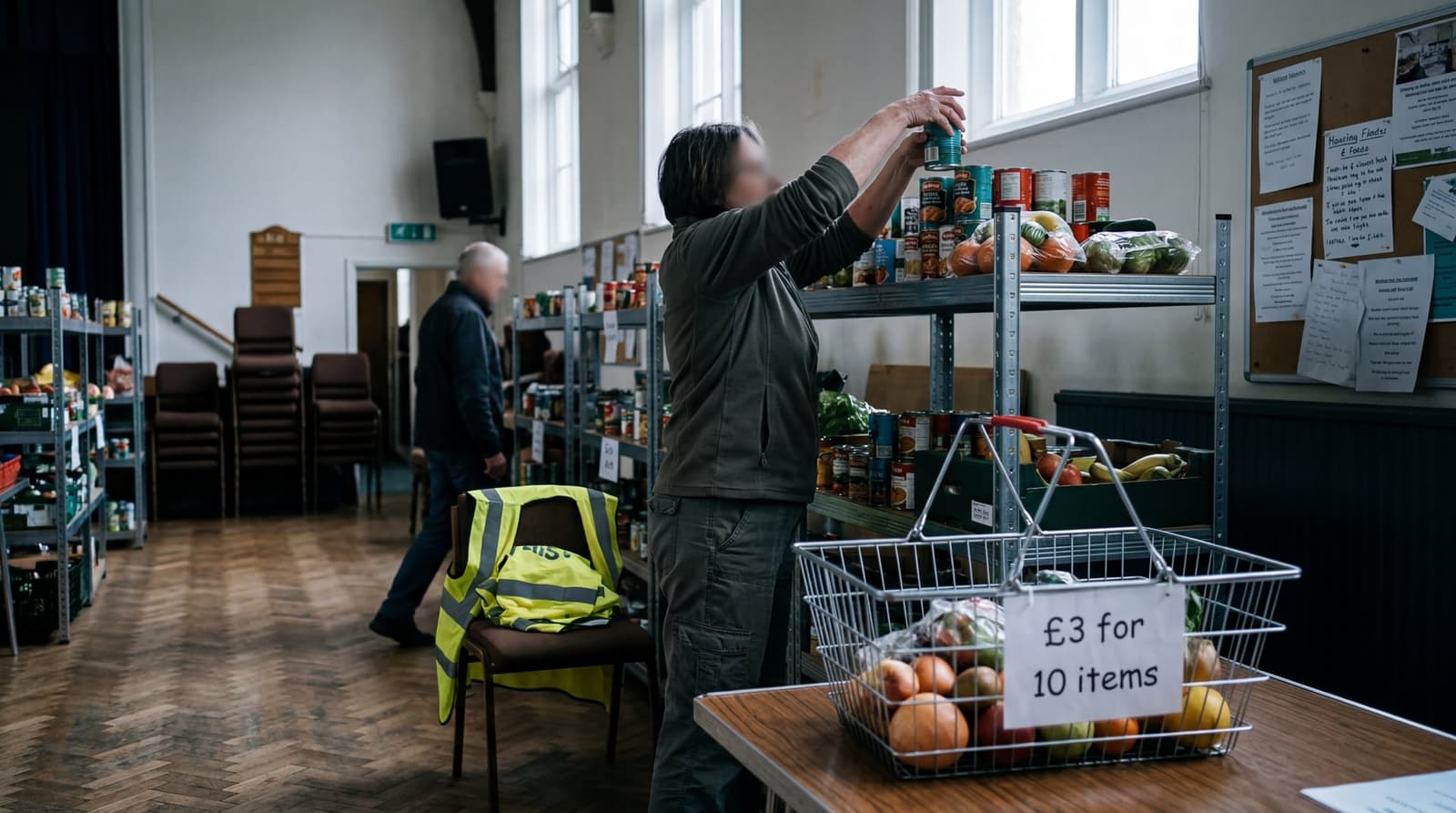
The foodbank's response to in-work poverty has been to build a second tier of provision alongside its emergency parcels. Its Fairbite Food Clubs operate as social supermarkets: members referred by a professional agency pay £3 to £5 a week for seven to ten items of food and household essentials. The first club opened in 2018. Four of the current six locations were added in 2024–25.
The model is explicitly designed for households whose incomes don't stretch to a weekly shop but who aren't in the acute crisis a three-day emergency parcel addresses. In practice, that increasingly means people in work.
"Cambridge is one of the most unequal cities in the UK, but we are hugely grateful to the people and businesses who are generously donating food and funds," Clay said in his February statement to CambsNews. Volunteers will contribute an estimated 32,000 hours to the operation this year, the charity said.
The approach raises an uncomfortable question that most coverage has skirted. If subsidised food becomes a permanent supplement to wages in a high-productivity city, has the local economy quietly normalised a two-tier subsistence model rather than fixed the underlying problem?
A national pattern, sharpened locally
What is happening in Cambridge tracks a national shift. Trussell distributed 2.9 million emergency food parcels across the UK in 2024–25, 69% higher than the same period five years earlier, according to a May 2026 House of Commons Library briefing. The charity's Hunger in the UK 2025 report found one in six UK households, around 14.1 million people including 3.8 million children, experienced food insecurity in 2024.
The Joseph Rowntree Foundation's UK Poverty 2026 report, cited by Cambridge City Foodbank, found a record 6.8 million people in "very deep" poverty, defined as living below 40% of median income.
Trussell has for several years identified in-work poverty as a primary driver of foodbank use nationally, alongside inadequate social security. Cambridge offers the cleanest case study of why: it pairs London-tier housing costs with non-London wage scales for the service and public-sector workers who keep the city running. Sustainable Food Places, in its Cambridge case study, put it plainly: "This is in a city that prides itself on its leading place in a global world and yet also holds the accolade for the most unequal city in the UK and Europe."
What the foodbank can't fix
Clay has been candid that 2024 was "the most challenging year in our Foodbank's history," and projections for 2026 point higher still. The charity's own framing acknowledges the limit of voluntary provision. The February council grant came with explicit language about strengthening relationships between organisations, not replacing structural fixes.
Those fixes sit outside the foodbank's control. They include the Greater Cambridge Housing Strategy's long-acknowledged affordability gap, the planning constraints that have throttled new housing supply alongside booming employment, and the wage floor in the sectors, hospitality, care, retail, cleaning, that staff the labs and offices producing the city's growth.
Until those move, the queue at Fairbite is likely to keep growing. The people in it will keep going to work the next morning.
Related stories
Six eggs used to cost £1. Here's why they're now £2.
UK egg prices have doubled in four years despite record production. The real story isn't greedflation, it's how prices move down much slower than they move up.
UK spends £25 on youth benefits for every £1 on jobs help, Milburn finds
The former Labour health secretary's interim NEET review lands on a government still bruised by last summer's welfare rebellion, and questions whether spending more on job schemes can fix a crisis now driven by mental…

Why your ice cream costs $6.49: a coconut, cocoa and corporate crisis
A record-hot summer pushed American ice cream prices to all-time highs. The deeper story runs through Philippine biodiesel mandates, West African droughts, and the breakup of the world's biggest ice cream company.
Frasers rebrands Castleford outlet 'Leeds'. The real story is a credit product.
Mike Ashley's retail group has slapped a city name and a buy-now-pay-later brand on a 26-year-old shopping centre built on a former Yorkshire colliery. Locals aren't impressed. The strategy underneath is bigger than the…
Keep Reading
Assyrian Christian Among 85,000 Prisoners Released in Iran Amid Coronavirus Pandemic

Northern Ireland's rarest rainforest gets a 100-year reboot in Tyrone

Four Jersey beaches flunk bacteria tests as island bakes in record May heat

Bionic arms for five-year-olds, a third thumb, and the 90% who get nothing

Trump tells new Fed chair Warsh to be 'totally independent' after year-long Powell feud