



Rare four-chick osprey brood hatches in Dorset as southern England recolonisation accelerates
All four eggs at the Poole Harbour nest hatched successfully, a roughly 1-in-100 outcome. The bigger story is what's happening beyond this single nest.

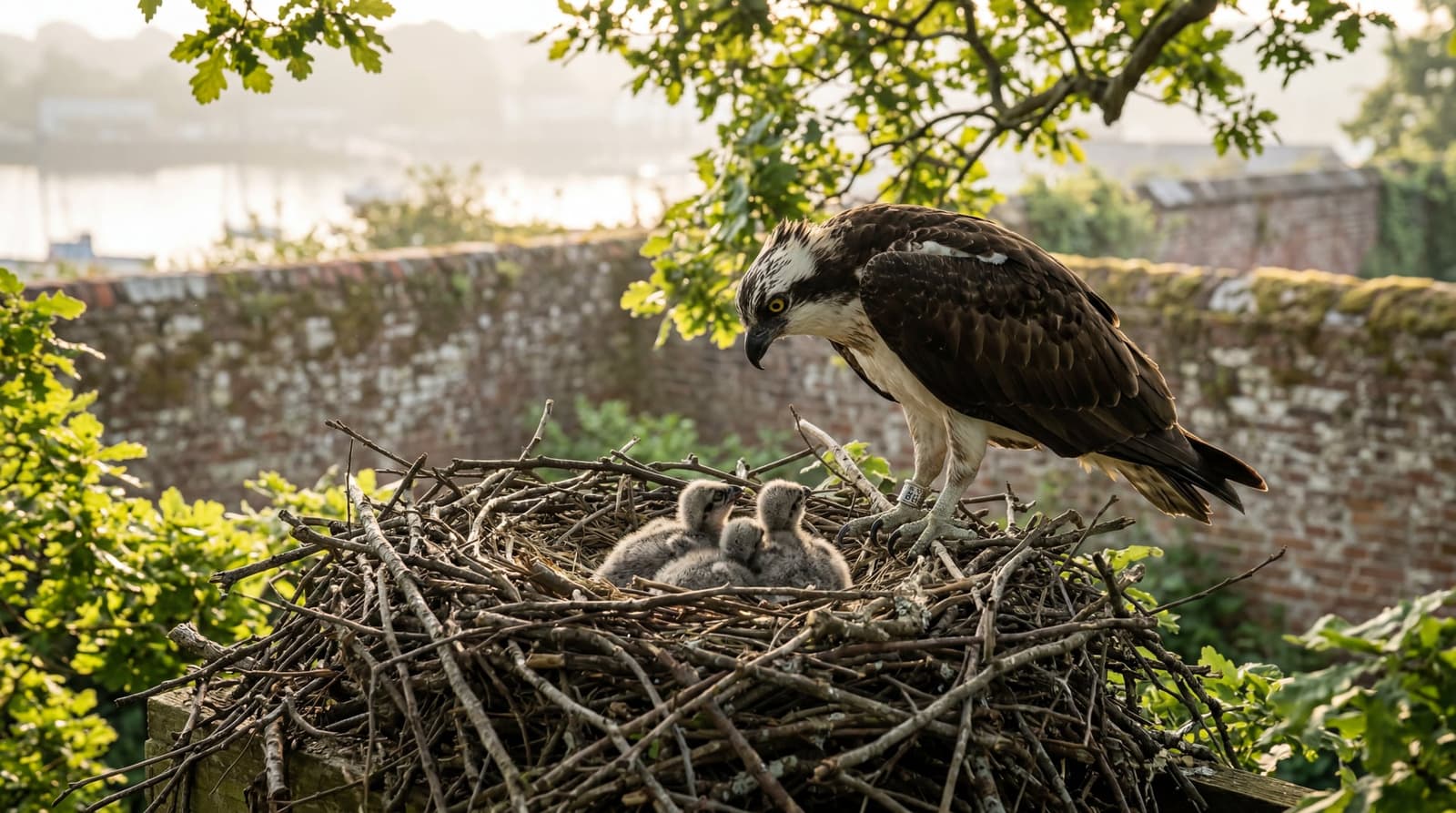
The first osprey chick of the 2025 breeding season in southern England broke from its shell at 05:29 BST on Thursday, 22 May, inside a walled garden on the edge of Poole Harbour in Dorset, according to Birds of Poole Harbour.
A second chick followed by 19:00 the same evening. A third arrived late on Saturday 24 May, and the fourth and final chick hatched in the early hours of Wednesday 28 May, the charity's 2025 Osprey Diary records. All four eggs in the clutch hatched successfully, an outcome the project describes as exceptionally rare. Roughly 1% of osprey clutches contain four eggs, and a clean sweep on hatching is rarer still.
The parents, female CJ7 and male 022, remain the only established breeding osprey pair in southern England. They are now four-for-four on consecutive breeding seasons since 2022, with a running tally of nine chicks raised.
A timestamp worth correcting
Some outlets, including the BBC, reported the first hatch at 15:10 BST. The primary source, Birds of Poole Harbour's own harbour update published the same day, logs the moment at 05:29 BST. The later time appears to reflect a subsequent observation or an editorial slip rather than the actual emergence from the egg.
It's a small detail. But for a nest watched 24 hours a day on live webcams, and guarded by the Dorset Police Rural Crime Team and the National Wildlife Crime Unit, the timing of milestones is the data conservationists actually use.
Not just one nest
The charming single-hatch framing favoured by most coverage misses what 2025 actually represents. For the first time, the Poole Harbour project has a second breeding pair on territory: translocated male 374 paired with Rutland-fledged female 1H1. They fledged two chicks at a separate "Nest 2" site this summer, according to Birds of Poole Harbour's news archive.
Further east, Norfolk Wildlife Trust confirmed the first osprey breeding pair in East Anglia in more than 250 years, at Ranworth Broad, in June 2025.
Read together, the three milestones (a record-equalling four-chick brood at Careys, a second productive Poole pair, and a Norfolk first) point to something the annual-feel-good frame doesn't capture: range consolidation across southern England, not just an isolated nest's annual output.
How a Rutland bird ended up running the south coast
Ospreys were effectively extinct as breeding birds in England by 1840 and across Britain by 1916, wiped out by persecution, egg-collectors and later DDT. The last confirmed breeding in southern England was on the Somerset Levels in 1847. A natural recolonisation began in Scotland in 1954, and the UK population has climbed from two known pairs in 1967 to roughly 300 today, almost all in Scotland.
Poole Harbour, with its shallow, fish-rich waters, had long been a passage stop for migrating ospreys but never a breeding site. The problem is natal philopatry: ospreys return to breed where they themselves fledged, and no living birds remembered Poole as home.
The fix was translocation. From 2017, Birds of Poole Harbour and the Roy Dennis Wildlife Foundation, working under a Natural England licence, released 60 juvenile Scottish ospreys into the harbour area to imprint them on the location before their first migration to West Africa.
CJ7, fledged at Rutland Water in 2015, was not herself translocated. She was drawn to Poole by the released juveniles and settled from 2020. Male 022, a 2019 translocation release, returned in May 2021. The pair bonded immediately and bred for the first time in 2022, the first successful osprey nesting in southern Britain since 1847.
Why the project's founder keeps making the same point
Paul Morton, who founded Birds of Poole Harbour and has been the project's principal spokesman since its inception, framed the original 2022 hatch in language he has not really softened since.
The restoration of lost species and biodiversity takes time, and don't forget, if humans hadn't got rid of Ospreys in the first place, we wouldn't have even needed to do a reintroduction.
That insistence on framing reintroduction as repair rather than novelty matters now, because the project is starting to throw off returnees of its own. In 2024, female chick 5H1, hatched at the Poole nest in 2022, became the first wild-fledged chick from the project to complete the round-trip migration to West Africa and back, Great British Life reported.
That is the moment a translocation programme stops being a release scheme and starts being a population.
The legal and logistical scaffolding
Ospreys are Schedule 1 species under the Wildlife and Countryside Act 1981, meaning disturbance at or near an active nest is a criminal offence. The exact coordinates of the Careys Secret Garden nest are deliberately withheld. Public engagement runs through controlled guided tours operated by Birds of Poole Harbour and the estate, a model consciously borrowed from the RSPB's "Operation Osprey" at Loch Garten in the 1950s.
The nest itself sits inside a walled garden on the Carey Estate, on the fringes of the harbour. Live webcams stream around the clock, and the site is co-protected by Dorset Police's Rural Crime Team and the National Wildlife Crime Unit, according to Birds of Poole Harbour.
BCP Council, in a statement on the 2025 record-equalling clutch, called the nest "so important for the recolonisation of this special species on the south coast," adding that "every chick that fledges from the nest is a reason to celebrate" (BCP Council).
What to watch next
The immediate question is fledging success. Four eggs hatching is not four chicks flying; the 2022 cohort lost female 5H2 to a goshawk shortly after fledging, a reminder that the gap between hatch and migration is the dangerous one.
The larger question is whether 2025 marks a tipping point. With a second Poole pair productive, a Norfolk first confirmed, and the project's own offspring beginning to come home, the southern English osprey population is starting to look less like a single nest's good run and a bit more like a network.
Related stories
Northern Ireland's rarest rainforest gets a 100-year reboot in Tyrone
Ulster Wildlife has planted nearly 30,000 native trees at Lenamore Wood, the first Northern Irish site in Aviva's £38.9m Celtic Rainforest programme. The genetic detail matters more than the photo op.
Four Jersey beaches flunk bacteria tests as island bakes in record May heat
Officials blame rainfall runoff for 'poor' water quality at Plemont, Grouville, Havre des Pas and Victoria Pool, even as Jersey breaks its all-time May temperature record.
SpaceX's Starship V3 ends in planned Indian Ocean fireball, two days after $80B IPO filing
Flight 12 broke a seven-month launch drought and delivered most of its test goals. The timing, just 48 hours after SpaceX's S-1 hit the SEC, gave the spectacle a second audience: Wall Street.
Somerset's fox count just doubled in 10 days. That's a problem.
A county citizen science project logged more red foxes in a week and a half than official records typically capture in two years, exposing a structural blind spot in how Britain monitors its most familiar wildlife.
Keep Reading
Assyrian Christian Among 85,000 Prisoners Released in Iran Amid Coronavirus Pandemic
UK's River Wye gets a rights charter. Will polluters notice?

The race to shrink the astronaut gym before Mars

Six eggs used to cost £1. Here's why they're now £2.
In Cambridge, a paycheck no longer keeps workers out of the food bank