



Four Jersey beaches flunk bacteria tests as island bakes in record May heat
Officials blame rainfall runoff for 'poor' water quality at Plemont, Grouville, Havre des Pas and Victoria Pool, even as Jersey breaks its all-time May temperature record.

Four of Jersey's 16 monitored bathing beaches returned 'poor' bacteria readings in seawater samples taken on 18 and 19 May 2026, prompting a public advisory to stay out of the water just as the island broke its all-time May temperature record.
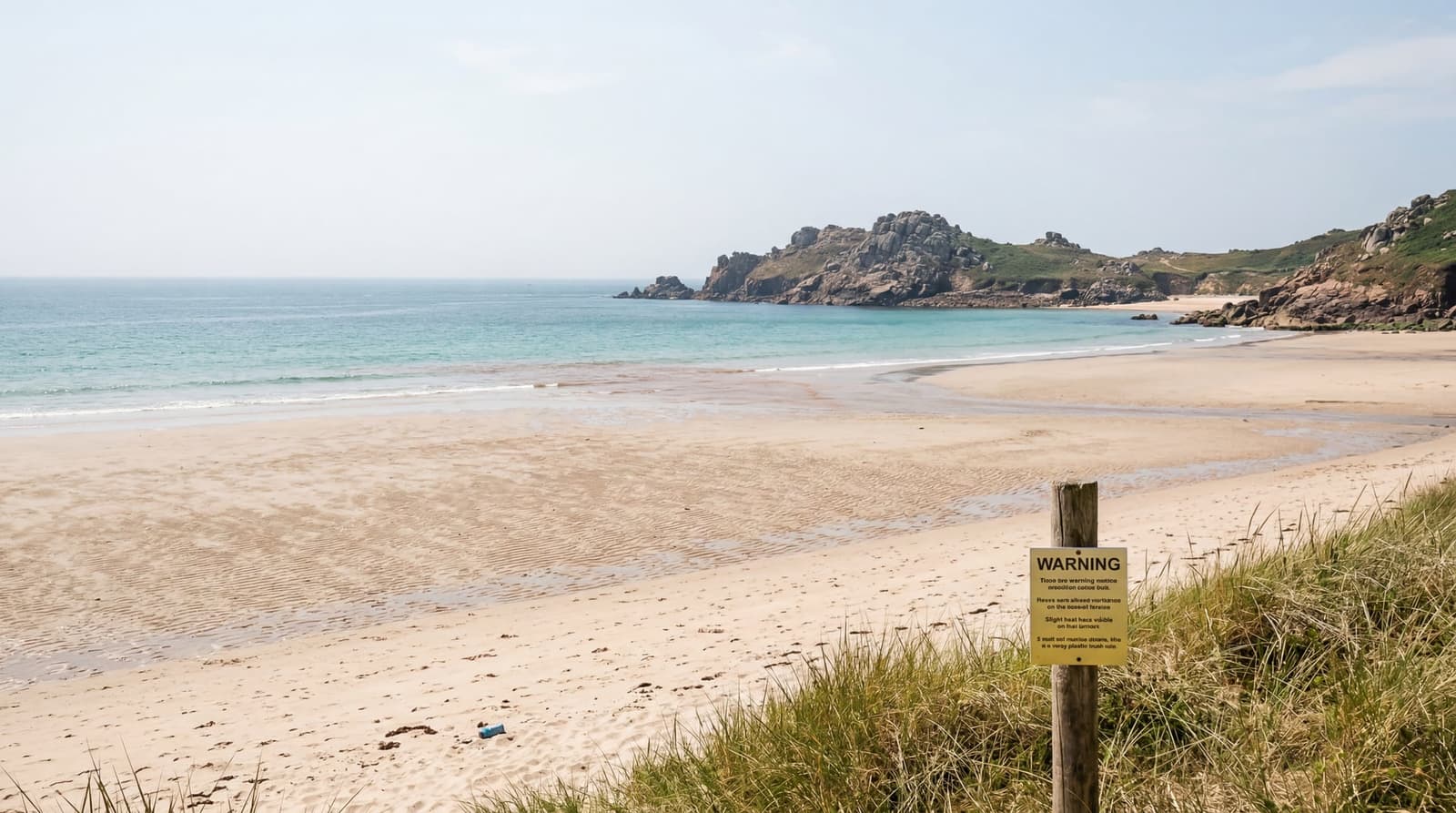
The Government of Jersey's Infrastructure and Environment Department said samples from Plemont in St Ouen, Long Beach at Grouville, Havre des Pas in St Helier and the nearby Victoria Pool all exceeded acceptable thresholds for faecal indicator bacteria. The department attributed the failures to heavy rainfall on Sunday 17 and Monday 18 May, and scheduled a follow-up sampling round for later that week, Bailiwick Express reported.
The timing was awkward. Jersey Met confirmed the island had passed 29°C, surpassing the previous May high of 28.9°C set on 20 May 2003, with 30°C forecast for the following day. Beaches were busy. Officials were telling people not to swim.
What the readings showed
Jersey's monitoring programme tests for Escherichia coli and intestinal enterococci, the two parameters required under the EU Bathing Water Directive. At Plemont, the intestinal enterococci reading came in at 223 colony-forming units per 100ml, narrowly above the 200 cfu/100ml threshold that triggers a 'poor' rating, according to the Jersey Evening Post. An 'excellent' classification requires a reading below 100 cfu/100ml.
The remaining 12 sites fared well in the same round. Eleven were rated 'excellent' and Green Island was rated 'good', the JEP reported on 24 May.
In its statement, the Infrastructure and Environment Department said:
Routine bacteriological seawater sampling taken on Monday 18 and Tuesday 19 May at Plemont, Grouville, Havre des Pas and Victoria Pool has identified unacceptable levels of bacteria in seawater in these locations. However, we believe that the poor results are due to significant rainfall events on Sunday and Monday. Heavy rainfall events cause run-off from land into the sea and we believe that the poor results are due to this natural occurrence.
The department's standing advice is that islanders should avoid entering the sea for at least 48 hours after heavy rainfall.
A 'natural occurrence', or a structural one?
The department's framing, that the spike was natural rather than infrastructural, is consistent with its long-standing position. It is also where the story gets more complicated than a one-day advisory suggests.
Four of the four failing beaches sit in very different parts of the island. Plemont is on the rugged north-west coast. Long Beach is on the gently sloping east. Havre des Pas and Victoria Pool sit on the urban south, next to St Helier. A simultaneous failure across that geography points to a pattern, not a localised incident.
Jersey is 117 square kilometres, with short, steep north-south valleys that drain directly to the sea. When the sky opens, water hits the coast quickly, carrying agricultural runoff from the island's farms, urban stormwater from St Helier and, during heavier events, the contents of combined sewer overflows. The bacteria that show up in the samples have to come from somewhere on land.
The pattern is not new. A 1995 peer-reviewed study of La Grève de Lecq on Jersey's north coast, published in the Journal of Applied Bacteriology, found that faecal indicator concentrations were "enhanced at high discharge after rainfall", citing stormwater and agricultural inputs. Thirty years on, the mechanism is the same.
That raises a question officials did not address this week: at what point does a recurring, predictable, rainfall-driven failure stop being a natural event and start being a capacity problem with drainage and sewerage infrastructure?
The voluntary compliance question
Jersey has tracked seawater quality since 1992 and weekly sampling at 16 bays runs from mid-May to 21 September, with results published on an interactive map on gov.je and accessible via QR codes at the beaches themselves. The system is, by the standards of small jurisdictions, transparent.
What it is not is binding. As a Crown Dependency, Jersey is not an EU member state and applies the Bathing Water Directive framework voluntarily. Inside the EU, a 'poor' classification under the directive triggers formal obligations including bathing prohibitions and corrective action plans. In Jersey, the same classification triggers a public advisory and a follow-up test.
The distinction matters less in a single bad week and more across years. Jersey's voluntary alignment means there is no external regulator to push for infrastructure upgrades when a beach repeatedly fails after rainfall, and no penalty mechanism if it does.
For swimmers wondering what to do with the rest of the bathing season, the practical guidance from the department is simple enough:
- Check the online map before heading to the coast.
- Avoid swimming for at least 48 hours after heavy rain.
- Pay attention to QR-coded notices at sampling points.
- Assume urban and estuarine beaches recover more slowly than exposed Atlantic coves.
The wider pattern
Jersey is far from alone. Across Europe, the European Environment Agency's most recent bathing water assessment notes that intense rainfall events, increasingly common in a warming climate, are a leading driver of short-term pollution spikes at otherwise clean beaches. The European Commission itself has acknowledged that the Bathing Water Directive, now more than a decade old, needs modernising to better account for short-term pollution and emerging contaminants.
In England, the Environment Agency has been more explicit, writing last year that climate-driven rainfall patterns are exposing the limits of drainage and sewerage networks designed for a different era.
Jersey's officials are right that one rainy weekend will not redefine its beaches. Under the directive's four-year rolling classification, a single 'poor' reading does not downgrade a site's annual status. The longer-term picture is what matters.
Whether that longer-term picture stays as flattering as the department suggests will depend less on the weather and more on what, if anything, gets done about the infrastructure underneath it.
Related stories
Northern Ireland's rarest rainforest gets a 100-year reboot in Tyrone
Ulster Wildlife has planted nearly 30,000 native trees at Lenamore Wood, the first Northern Irish site in Aviva's £38.9m Celtic Rainforest programme. The genetic detail matters more than the photo op.
SpaceX's Starship V3 ends in planned Indian Ocean fireball, two days after $80B IPO filing
Flight 12 broke a seven-month launch drought and delivered most of its test goals. The timing, just 48 hours after SpaceX's S-1 hit the SEC, gave the spectacle a second audience: Wall Street.
Somerset's fox count just doubled in 10 days. That's a problem.
A county citizen science project logged more red foxes in a week and a half than official records typically capture in two years, exposing a structural blind spot in how Britain monitors its most familiar wildlife.
UK's River Wye gets a rights charter. Will polluters notice?
Herefordshire and Powys councils have adopted the first source-to-sea rights charter for a UK river. Campaigners and lawyers are already asking what it actually changes.
Keep Reading
Assyrian Christian Among 85,000 Prisoners Released in Iran Amid Coronavirus Pandemic

The race to shrink the astronaut gym before Mars

Rare four-chick osprey brood hatches in Dorset as southern England recolonisation accelerates

Six eggs used to cost £1. Here's why they're now £2.
In Cambridge, a paycheck no longer keeps workers out of the food bank