




Welsh minister says muck-spreading ban 'doesn't work' as rivers crisis deepens
A new cabinet secretary has broken with the previous government's defence of Wales's farm pollution rules, eight months after an independent review said they should stay.

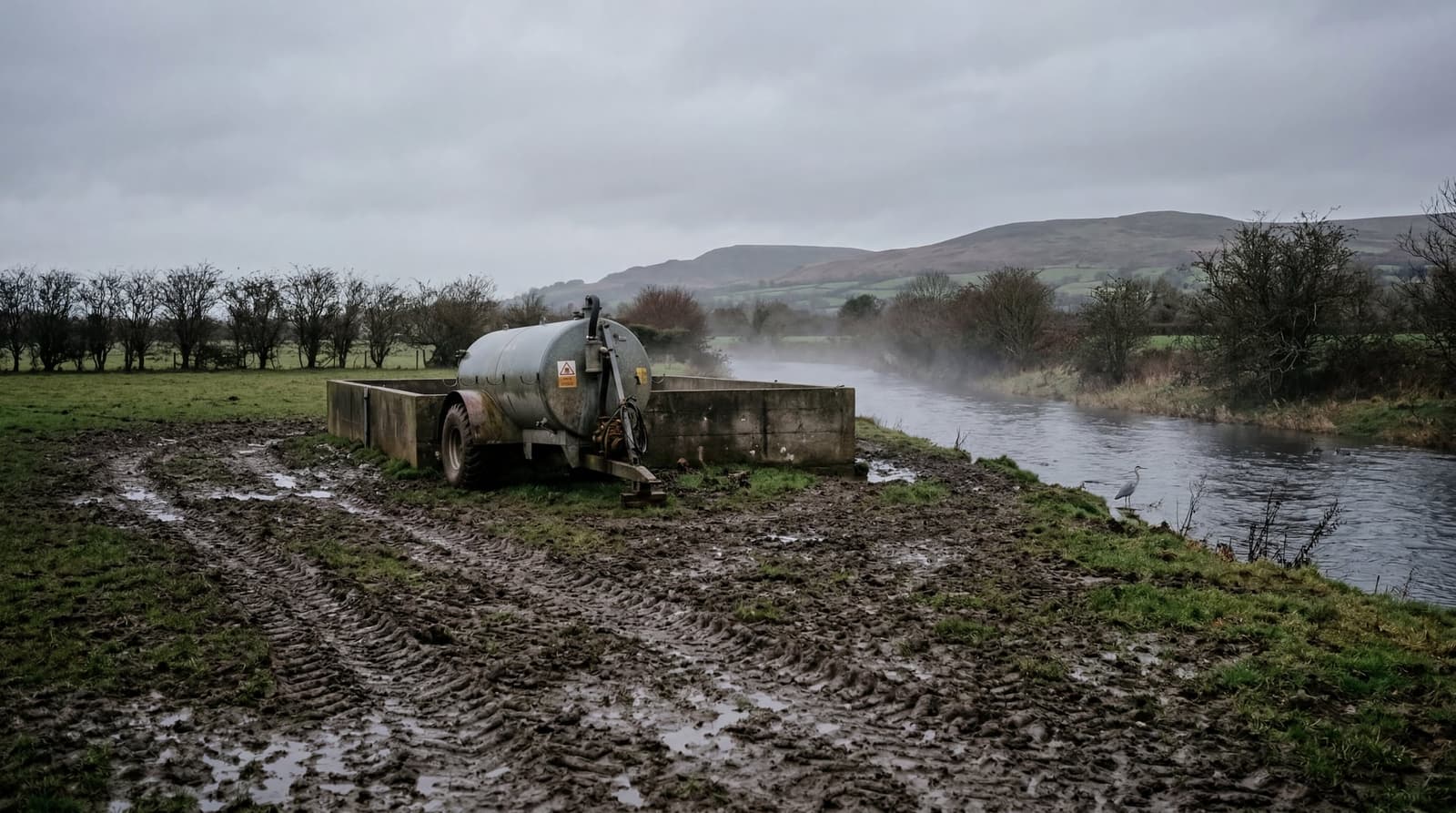
Wales's new minister for rural affairs has declared that the country's controversial muck-spreading restrictions 'do not work,' opening the door to the first significant rewrite of the rules since they took effect in 2021, the BBC reported.
The assessment marks a sharp political break from the previous administration, which in March accepted all 23 recommendations of an independent statutory review and kept the entire country designated as a Nitrate Vulnerable Zone. The Water Resources (Control of Agricultural Pollution) (Wales) Regulations 2021, known as CoAP, impose a closed period for slurry spreading from 1 October to 1 March, cap nitrogen from livestock manures at 170 kg per hectare, and require farms to build storage to hold months of slurry.
The rules have cost some dairy farmers more than £200,000 in infrastructure upgrades, according to figures cited by Farmers Weekly. They have also done little to halt a phosphorus pollution crisis that has left more than 60% of Wales's protected rivers, including the Wye and the Usk, failing water quality targets.
A review that said keep the rules
The four-year statutory review, chaired by independent expert Dr Susannah Bolton, was published on 31 March 2025. It concluded the regulations were working and should be retained in full, including the all-Wales NVZ designation, according to the Welsh Government written statement.
Then Deputy First Minister Huw Irranca-Davies accepted every recommendation. 'Water quality in Wales is still being detrimentally impacted and we must continue to make improvements,' he said in the statement.
The Welsh Government has put £52 million into farm infrastructure grants since the rules took effect, and committed a further £1.58 million to Natural Resources Wales for enforcement in 2025–26.
But the review itself flagged a problem its own recommendations could not solve. Bolton wrote that the regulation 'does not adequately address other pollutants, including phosphorous and soil run-off, which may in some situations represent an even greater risk,' in the published review.
Phosphorus, not nitrate, is the pollutant most often cited as the cause of the algal blooms and ecological collapse seen in the Wye and Usk catchments.
Farmers say nothing changed; campaigners say nothing was enforced
The political reaction to the March review was hostile from both directions. NFU Cymru president Aled Jones said 'farmers will be extremely annoyed that nothing has materially changed,' in comments to Farmers Weekly. A 2024 NFU Cymru survey of 400 farmers cited in the same report found the rules had forced many to restructure their businesses, with significant impacts on mental health.
The Farmers' Union of Wales has argued the closed periods are unworkable on Welsh soils and weather, and that the record-keeping burden is disproportionate to the environmental gain.
Environmental groups draw the opposite conclusion. Wildlife Trusts Wales has said any weakening would be 'a significant backward step in nature's recovery,' and argues the real failure is enforcement, not the rules themselves. Natural Resources Wales was meant to recruit 20 dedicated enforcement officers; by late 2023, only 12 were in post for the whole country, according to the North Wales Wildlife Trust.
A Welsh Government report cited by Friends of the River Wye in January 2026 found only 41% of Welsh farms were compliant with environmental regulations.
The phosphorus gap
That 41% figure is the awkward number underneath the political fight. If most farms are not following the rules, then declaring the rules a failure is at best premature. It is also possible that even full compliance would not fix the rivers, because the rules largely target the wrong pollutant.
Afonydd Cymru, the umbrella body for Welsh Rivers Trusts, has called the slurry closed season a foundational anti-pollution measure. 'Slurry mismanagement remains one of the main causes of agricultural pollution,' the group has said. Salmon stocks in Welsh rivers have crashed by 42% and every river in Wales is now classed as 'at risk,' according to Wildlife Trusts Wales.
The pressure is not only political. A High Court case brought by more than 4,500 claimants against poultry processor Avara Foods, Freemans of Newent and Welsh Water over pollution in the Wye, Lugg and Usk is scheduled for its first hearing on 27 April 2026. The case targets intensive poultry units in the upper Wye catchment, an industry the CoAP rules barely touch because chicken litter is not slurry and falls outside the closed-period regime.
What reform could look like
The minister has not yet published a replacement framework. Officials have indicated possible flexibility on the closed periods, which farmers say lock them out of spreading during mild winter weather windows, and on the 170 kg/ha cap.
Any serious rewrite would have to address three problems the current rules do not solve:
- Phosphorus loading from poultry units and soil run-off, the dominant cause of SAC river failures.
- Enforcement capacity at NRW, which has never been resourced to inspect the country's roughly 24,000 farms at meaningful frequency.
- The compliance cliff facing dairy farmers who have already spent six-figure sums on storage built to a standard that may now be revised.
For farmers like the Aberystwyth dairyman who spent £200,000 on slurry storage, the prospect of a fresh regulatory regime is its own kind of penalty. For anglers on the Wye, watching salmon redds disappear under algal mats, the prospect of weaker rules is worse.
The minister's verdict that the ban 'doesn't work' may be the easiest part of the argument. Designing something that does is the harder question, and one the 2025 review came closer to ducking than answering.
Related stories
Northern Ireland's rarest rainforest gets a 100-year reboot in Tyrone
Ulster Wildlife has planted nearly 30,000 native trees at Lenamore Wood, the first Northern Irish site in Aviva's £38.9m Celtic Rainforest programme. The genetic detail matters more than the photo op.
Four Jersey beaches flunk bacteria tests as island bakes in record May heat
Officials blame rainfall runoff for 'poor' water quality at Plemont, Grouville, Havre des Pas and Victoria Pool, even as Jersey breaks its all-time May temperature record.
SpaceX's Starship V3 ends in planned Indian Ocean fireball, two days after $80B IPO filing
Flight 12 broke a seven-month launch drought and delivered most of its test goals. The timing, just 48 hours after SpaceX's S-1 hit the SEC, gave the spectacle a second audience: Wall Street.
Somerset's fox count just doubled in 10 days. That's a problem.
A county citizen science project logged more red foxes in a week and a half than official records typically capture in two years, exposing a structural blind spot in how Britain monitors its most familiar wildlife.
Keep Reading
Assyrian Christian Among 85,000 Prisoners Released in Iran Amid Coronavirus Pandemic

UK's River Wye gets a rights charter. Will polluters notice?

The race to shrink the astronaut gym before Mars

Six eggs used to cost £1. Here's why they're now £2.
In Cambridge, a paycheck no longer keeps workers out of the food bank