


Durham's rarest grassland gets a £975,000 reset, but the species data isn't in yet
A two-year restoration along the only coast on Earth where magnesian limestone meets the sea has wrapped up. The harder question, whether the wildlife actually returns, is still being measured.

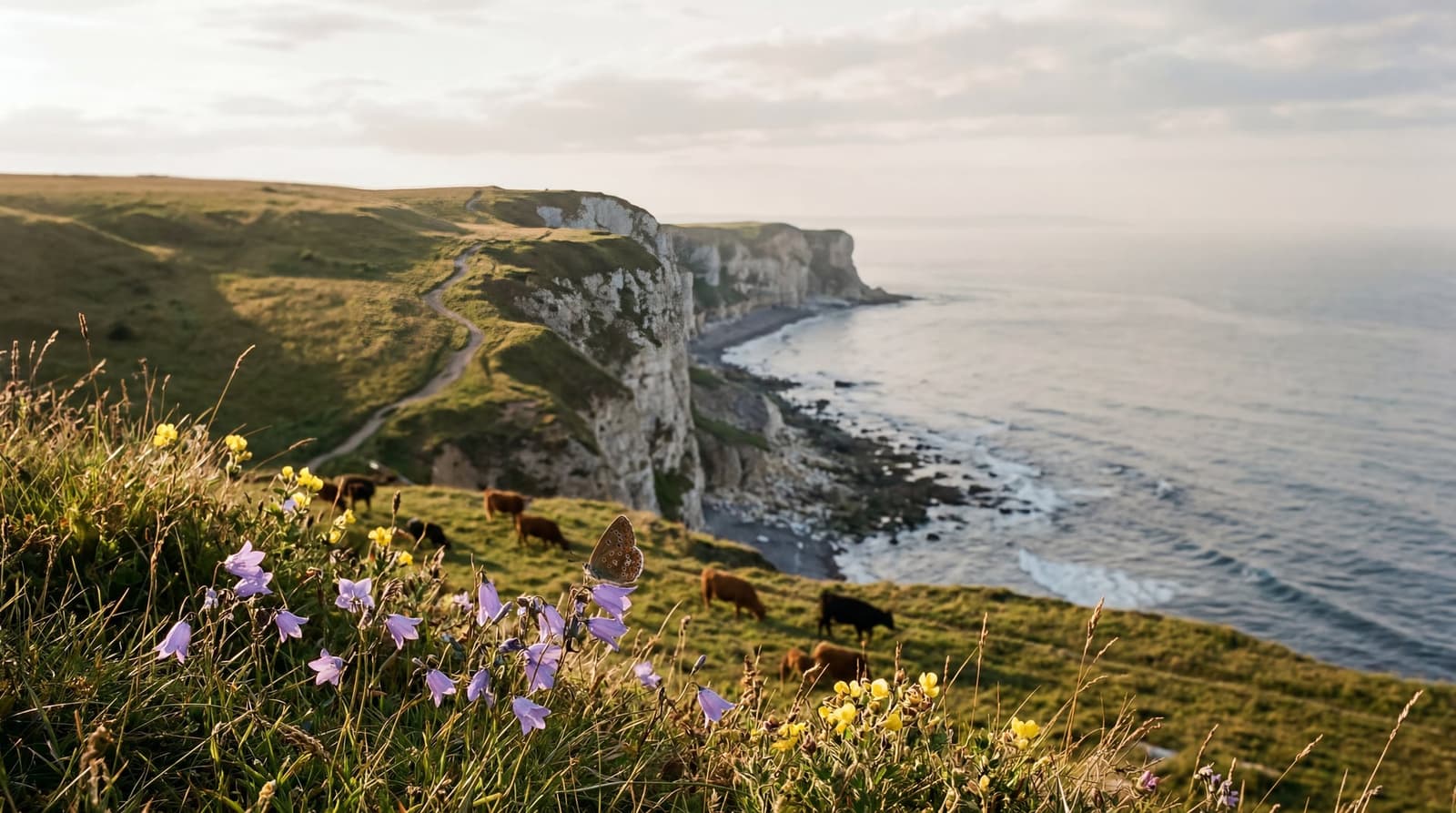
A two-year project to restore 213 hectares of one of the world's rarest grassland habitats has been completed along the Durham coast, the partners behind it announced this week. The Coastal Grasslands Reconnected scheme, funded by a £975,150 grant from the UK Government's Species Survival Fund, ran from 2024 to February 2026 and covered the cliffs and slopes from Nose's Point near Seaham south to Blackhall Rocks.
The headline numbers, published by Durham County Council, are substantial: nine new ponds, more than 21,000 trees and shrubs planted at Tina's Haven nature reserve in Horden, over 11km of upgraded paths, a refurbished high-tide roost for wading birds at Blackhall Rocks, and fencing installed to allow cattle grazing across reclaimed ground. Around 1,000 adult volunteers and 1,100 pupils from 13 local schools took part, the council said.
What the announcement does not yet contain is independently verified data on whether the species the project was designed to save are recovering. That assessment, commissioned from Land Use Consultants, is ongoing.
A habitat that exists nowhere else
The Durham Heritage Coast is the only place on Earth where magnesian limestone, laid down roughly 225 million years ago in the Permian period, is exposed directly at the coast. The narrow geological band runs from Nottinghamshire to Tyneside, and roughly a third of the UK's total magnesian limestone grassland sits on the Durham coast, according to Durham Wildlife Trust. More than 279 of the 307 hectares in the North East hold SSSI designation under the Wildlife and Countryside Act 1981.
The ecological roll call is unusual for somewhere this small. ERIC North East records list 84 nationally scarce invertebrates and 13 nationally scarce plants tied to the habitat, including dark red helleborine and bee orchids, the Least Minor moth, and the Northern Brown Argus butterfly, informally known as the 'Durham Argus' because it was first described at Castle Eden Dene.
That decline is the part most coverage has skimmed past. The Northern Brown Argus, the habitat's keystone indicator, fell 39% in distribution between 2010 and 2019 and 57% nationally between the 1980s and 2020, per Buglife. Agricultural intensification since the Second World War has eaten through most of the original resource, with the strongest surviving fragments now confined to steep slopes, road verges, and disused quarries.
From colliery spoil to skylarks
The restoration sits at the end of a longer arc. From the 1830s, collieries tipped spoil straight onto the beaches; Blackhall Rocks became blackened enough to serve as a filming location for Alien 3 and Get Carter. The 'Turning the Tide' clean-up in the late 1990s removed about 1.3 million tonnes of that material and created roughly 80 hectares of new habitat, which paved the way for Heritage Coast designation in 2001.
Where colliery spoil once blackened the beaches, now we have seals basking and sky larks singing.
Niall Benson, Heritage Coast Officer, Durham County Council, speaking to the Sunderland Echo
Where the previous phase was industrial remediation, this one is ecological reconstruction. Crews scraped away nutrient-rich agricultural topsoil in places to expose the limestone subsoil that specialist plants need, then reintroduced grazing cattle behind new fencing. Wildflower meadows were restored, hedgerows planted, and the high-tide roost at Blackhall Rocks rebuilt for waders, according to the LUC evaluation brief.
Eric Wilton, general manager for the National Trust's Derwent, Wear and Coast portfolio, said the scheme had "delivered a great deal for both nature and communities, providing habitat corridors to allow key wildlife species to move across the landscape" (Durham County Council statement).
The data gap
The "success" framing, for now, rests on activity outputs: hectares treated, trees planted, events held, volunteers turned out. Nearly 100 community events ran across the two years, and citizen scientists logged more than 900 species observations using the iNaturalist app, supported by a 'Durham Dozen' identification guide aimed at first-time recorders, Durham Magazine reported.
Whether the Northern Brown Argus, the orchids, and the scarce invertebrates respond at population level is a longer question. Magnesian limestone grassland is slow to assemble; published restoration ecology on calcareous grasslands suggests species composition can take a decade or more to converge on reference sites. The LUC evaluation will report on environmental and social outcomes against the project's targets, but no headline species abundance figures have been published alongside the completion announcement.
Cllr Kyle Genner, Durham County Council's cabinet member for neighbourhoods and environment, said the combined works had "helped to restore the grasslands, improve roosting for birds and create diverse habitats and better conditions for a range of plants and wildlife."
What happens to the rest of the £25m
Coastal Grasslands Reconnected is one of 20 projects sharing a £25 million national Species Survival Fund, jointly run by Defra and the National Lottery Heritage Fund, which targeted more than 3,300 hectares of habitat restoration across England, the government announced in March 2024. The fund is closed to new applications.
That matters because the 20 projects are all reaching completion in a similar window, and each was structured as a discrete capital intervention rather than a long-term management endowment. Grazing regimes, scrub control, and monitoring on sites like the Durham coast will need ongoing funding from the partner organisations or from successor schemes that have not yet been announced. The Species Survival Fund was pitched as a contribution to the UK's legally binding target to halt species decline and protect 30% of land for nature by 2030, a goal set under the Environmental Improvement Plan.
For Durham, the immediate test is narrower. The cattle are back on the cliffs, the ponds hold water, and the paths are open. Whether the Durham Argus comes back in any numbers is the measure that counts, and it is the one not yet on the scoreboard.
Related stories
Northern Ireland's rarest rainforest gets a 100-year reboot in Tyrone
Ulster Wildlife has planted nearly 30,000 native trees at Lenamore Wood, the first Northern Irish site in Aviva's £38.9m Celtic Rainforest programme. The genetic detail matters more than the photo op.
Four Jersey beaches flunk bacteria tests as island bakes in record May heat
Officials blame rainfall runoff for 'poor' water quality at Plemont, Grouville, Havre des Pas and Victoria Pool, even as Jersey breaks its all-time May temperature record.
SpaceX's Starship V3 ends in planned Indian Ocean fireball, two days after $80B IPO filing
Flight 12 broke a seven-month launch drought and delivered most of its test goals. The timing, just 48 hours after SpaceX's S-1 hit the SEC, gave the spectacle a second audience: Wall Street.
Somerset's fox count just doubled in 10 days. That's a problem.
A county citizen science project logged more red foxes in a week and a half than official records typically capture in two years, exposing a structural blind spot in how Britain monitors its most familiar wildlife.
Keep Reading
Assyrian Christian Among 85,000 Prisoners Released in Iran Amid Coronavirus Pandemic
UK's River Wye gets a rights charter. Will polluters notice?

The race to shrink the astronaut gym before Mars

Six eggs used to cost £1. Here's why they're now £2.
In Cambridge, a paycheck no longer keeps workers out of the food bank